
The System You Can’t See
We’re told the economy runs through banks. That’s the version most people still carry in their heads. Regulated institutions. Oversight. Rules that, at least in theory, protect the public from excess.
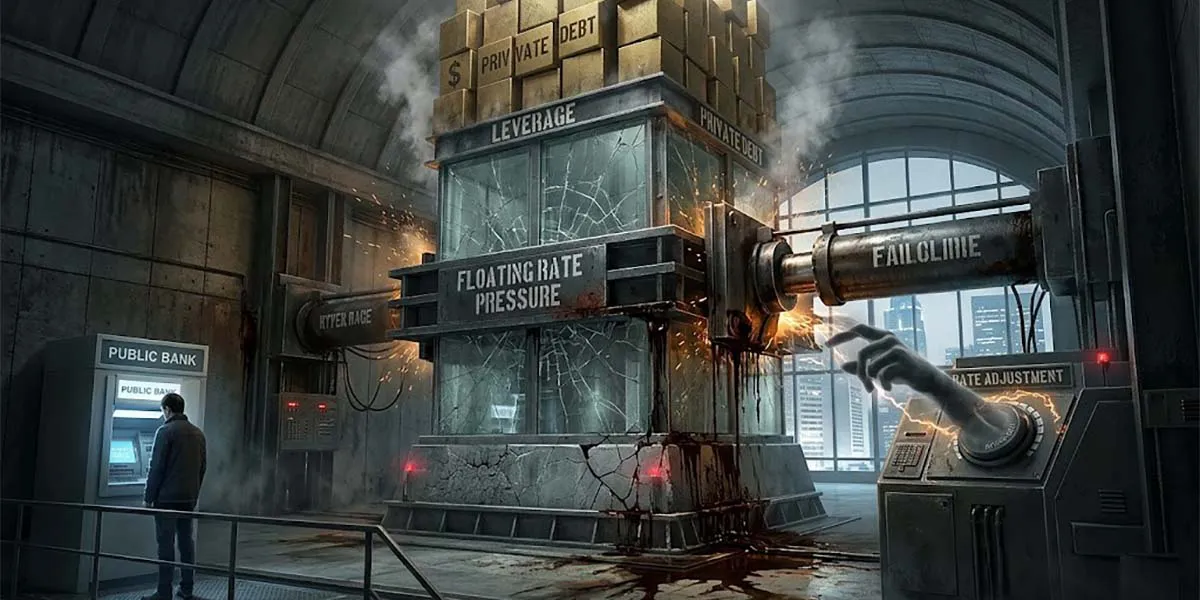
But that’s no longer where much of the real lending power sits.
Over the past decade, a parallel system has taken shape—one that operates largely outside public view. Trillions of dollars now move through private credit markets, controlled by firms like Blackstone, Apollo Global Management, and Ares Management. These firms are not banks, yet they now perform one of the most important functions in the economy: deciding who gets access to capital, and who doesn’t.
This shift didn’t happen through legislation the public debated. It wasn’t something voters approved or rejected. It emerged quietly, as banks pulled back under tighter regulations and private money stepped in to fill the gap.
And with that shift came a change in accountability.
Banks operate inside a system designed—at least in part—for public visibility. Private credit operates differently. There are fewer disclosure requirements, fewer stress tests, and far less transparency about the risks being taken. The system is not lawless, but it is less visible, and that difference matters.
Because when systems lack visibility, risk doesn’t disappear. It accumulates.
We’ve seen this before. In the years leading up to the 2008 financial crisis, financial risk was not absent—it was obscured. Confidence held because the structure looked stable from the outside, even as pressure built underneath.
Private credit is not the same structure, but it carries a similar tension. Many of the loans being issued are to companies already operating with significant debt. As interest rates rise, so do the costs of carrying that debt. The strain doesn’t appear all at once. It builds gradually, often out of sight.
At the same time, the investors funding these loans are not operating in a system designed for quick exits. Unlike public markets, where assets can be sold in seconds, private credit locks capital in place. That stability is part of its appeal—until conditions change.
If defaults begin to rise while investors grow uneasy, the system doesn’t unwind cleanly. It tightens. It slows. It resists adjustment. And that’s when stress begins to surface in ways that are harder to manage.
But the deeper issue isn’t just financial risk. It’s structural power.
When the flow of capital shifts into systems that operate with less oversight, control follows. Decisions about which businesses survive, which sectors expand, and where economic opportunity exists are increasingly shaped by institutions that sit further from public accountability.
That’s not a theory. It’s a change already underway.
And it raises a larger question—one that goes beyond finance.
If the systems that shape our economy are moving outside the reach of public visibility, then how much of what affects our daily lives is still truly within the system we believe we’re participating in?